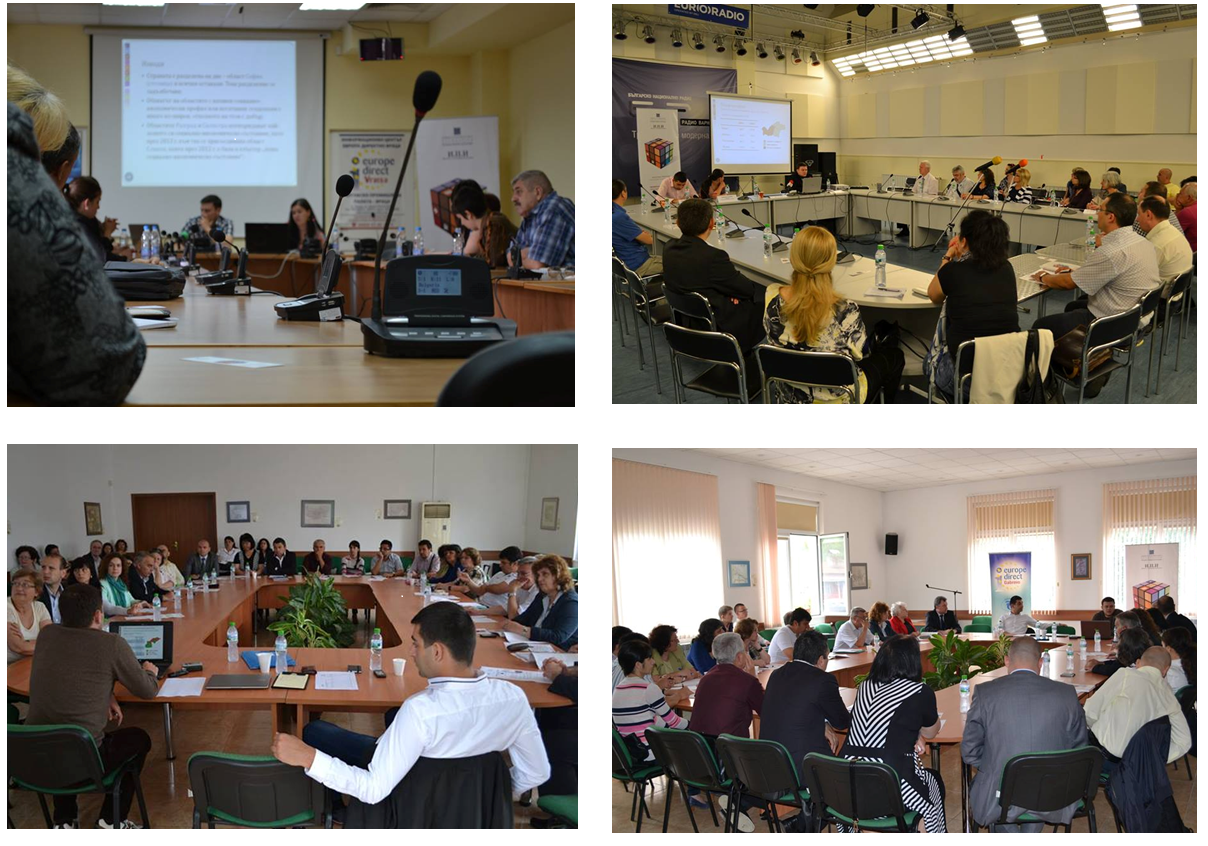
Presenting "Regional Profiles: Indicators of Development 2013"
The study was presented on November 14th 2013.
The study "Regional Profiles: Indicators of Development 2013" (Bulgarian version) presents the social and economic development of bulgarian districts. The study is based on 58 indicators, divided into eight categories: Economy, Administration and Taxes, Infrastructure, Demography, Education, Healthcare, Environment and Social Environment. A seperate profile of each of the districts can be found on our webpage.
The English version of the study will be available in January 2014 and will include all of the available analysis and data.
Some of the analysis included in the study show:
There is a connection between the assessment of businesses about the quality of administrative services and corruption perceptions
The speed and quality of the administrative services and the rule of law are two of the leading elements that determine local business environment. In May 2013 IME carried out a countrywide survey among 1680 companies as part of the upcoming second edition of the study “Regional profiles: Indicators of Development”[1].
Conclusions:
The assessment consists of several criteria such as staff qualification, skills and attitude, speed of the administrative services, clarity of local requirements and regulations and overall corruption perception. The overall assessment of the administration’s performance in 2013 is lower (3.3/5.0) than in 2012 (3.5/5.0).

Source: IME, „Regional profiles: Indicators of Development 2013“
Note: The spread shows the difference between the highest and the lowest ratings for every single characteristic of the administrative services. The evaluation is based on a five-point scale where 1 stands for ”very bad”, 3 means “average”, and 5 means “very good”.
The attitude of the staff and their qualification are the highest rated characteristic of local administrations in Bulgaria. . Even the lowest rated districts achieve results above 3 (average).
Meanwhile the speed of the administrative service and the clarity of local requirements of the administration remain the most problematic areas. The most considerable regional differences are also connected with these two characteristics.
Trends: Some minor structural changes in the business survey make a direct comparison between data from 2012 and 2013 improper. However, it is important to note that for a second consecutive year Burgas is one of the top 3 most highly rated districts, while Kyustendil is one of the districts that receives one of the lowest ratings. Among the five best performing districts for a second consecutive year are also Smolyan and Pazardzhik, whereas the administration services in Stara Zagora are still perceived as one of the worst.
The survey evaluates the corruption perception of local businesses in regard to the district and municipality administrations, police and judicial authorities, as well as the local Labor Inspectorate. In 2013, the overall corruption perception in the country has deteriorated from 3.4/5.0 to 3.3/5.0.

Source: IME, „Regional profiles: Indicators of Development 2013“
Note: The spread shows the difference between the highest and lowest rated districts in regard to corruption perception in each of the listed institutions. The evaluation is based on a five-point scale, where score 1 stands for “very high level of corruption”, 3 means “average levels of corruption” and 5 means “very low level of corruption”.
In terms of corruption perceptions there are serious discrepancies. The highest levels of corruption are considered to be in the municipalities and the judiciary system. The lowest levels of corruption are in the local sub-divisions of the Labor Inspectorate. Corruption is the highest in Veliko Turnovo, Kyustendil and Pernik, and the lowest levels are in Smolyan, Montana and Targovishte.
Trends: For second consecutive year, Smolyan and Targovishte are among the three regions with the lowest perception of corruption, while Pernik and Kyustendil have some of the highest. Veliko Turnovo once again ranks among the 5 regions with the highest corruption in the country.
Administrative services and corruption - For a second consecutive year the data show a connection (moderate positive correlation- 0.65) between business’ assessment for the quality of administrative services and corruption in the country.

Source: IME, „Regional profiles: Indicators of Development 2013“
Note: The assessment of the performance of local administration is based on a five-point scale, where score of 1 means “very bad”, 3 is “average” and 5 is “very good”. In evaluating corruption score 1 means “very high level of corruption”, 3 is “average” and 5 - “very low level of corruption”.
Irregular payments - nearly 15% of the respondents think that illegal payments from companies in their sector to the administration are made “often” or “very often” in order to obtain public procurement contracts. Around 12 % believe that it happens “often” or ‘very often” when it comes to getting registrations and permits from local authorities.

Source: IME, „Regional profiles: Indicators of Development 2013“
Electronic services are used by 21.7% of the companies with up to 10 employees and 34.7% of the companies employing between 11 and 50 people. Large companies are the ones that most often use e-services provided by the local administration - in the last 12 months preceding the survey 50.4 % of them did so. Small and medium businesses evaluate their quality as “rather high” (3.48/5.00). The assessment of the large companies is even higher- 3.77/5.00.

Source: IME, „Regional profiles: Indicators of Development 2013“
[1] The study will be presented on 14th November 2013. Along with the socio-economical development of the 28 districts in the country, the study includes several thematic analysis in various topics such as labor market development and trends in local tax policies.
The results of an IME business survey, carried out in the build-up to the study “Regional Profiles: Indicators of Development 2013” (to be published in November), indicate rather negative trends for the development of domestic labor markets in the next 12 months.
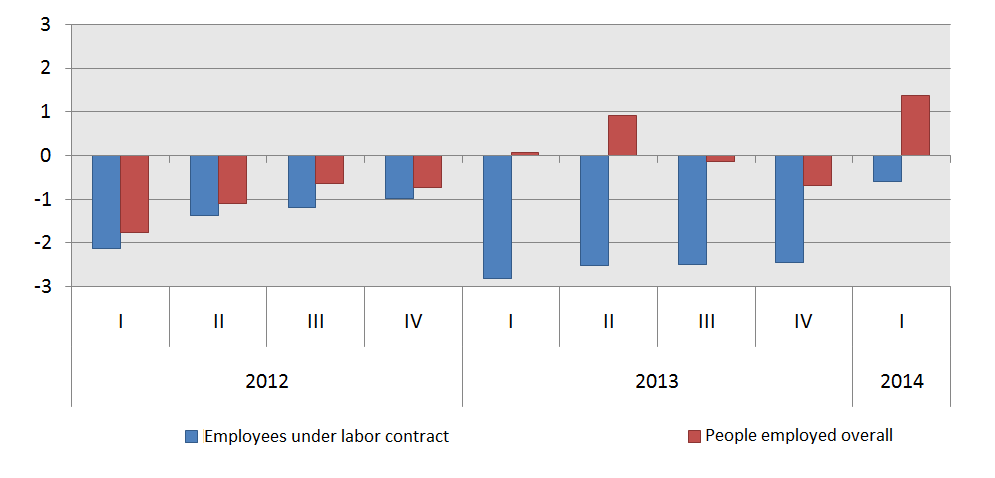
It appears that the Bulgarian economy has finally started to create jobs. In the second quarter of 2013 the number of employed people was 26,5 thousand higher compared to the same period last year. Meanwhile, slowing economic growth could have a reverse effect on this much awaited positive trend. The results of an IME business survey, carried out in the build-up to the study “Regional Profiles: Indicators of Development 2013” (to be published in November), indicate rather negative trends for the development of domestic labor markets in the next 12 months.
According to the data published this month by the National Statistical Institute (NSI), the increased number of employees in seasonal industries (agriculture, hotels and restaurants etc.) during the second quarter and the growth is significantly higher than the observed growth during the previous couple of years. In comparison to 2012, there are 13 thousand newly created jobs in agriculture and 14 thousand in “Hotels and Restaurants” .Therefore, it is hard to make a definite conclusion whether these new jobs in recent months are due to general improvements in the economy or just temporary effects as a result of a strong summer season.
The dynamics of the number of employed for the first two quarters in different regions of the country also point to rather strong seasonal trends. For the period April-May 2013 most openings have been created in districts with traditionally high occupation during the summer months. Compared with the first quarter of the year, the average number of employees under labor contract during the second quarter increased by 16,8% in Burgas, 7,8 % in Varna and 8,8 % in Dobrich. Other districts with good performance this year are Targovishte and Shumen. However, the increase in the number of employees there is only 2-3%. In 2012 these rates were 13,9% in Burgas, 7,0% in Varna and 5,7% in Dobrich.
In spite of the positive signs of growing employment, businesses are not quite as optimistic about the situation on the labor market in the country for this year and next.
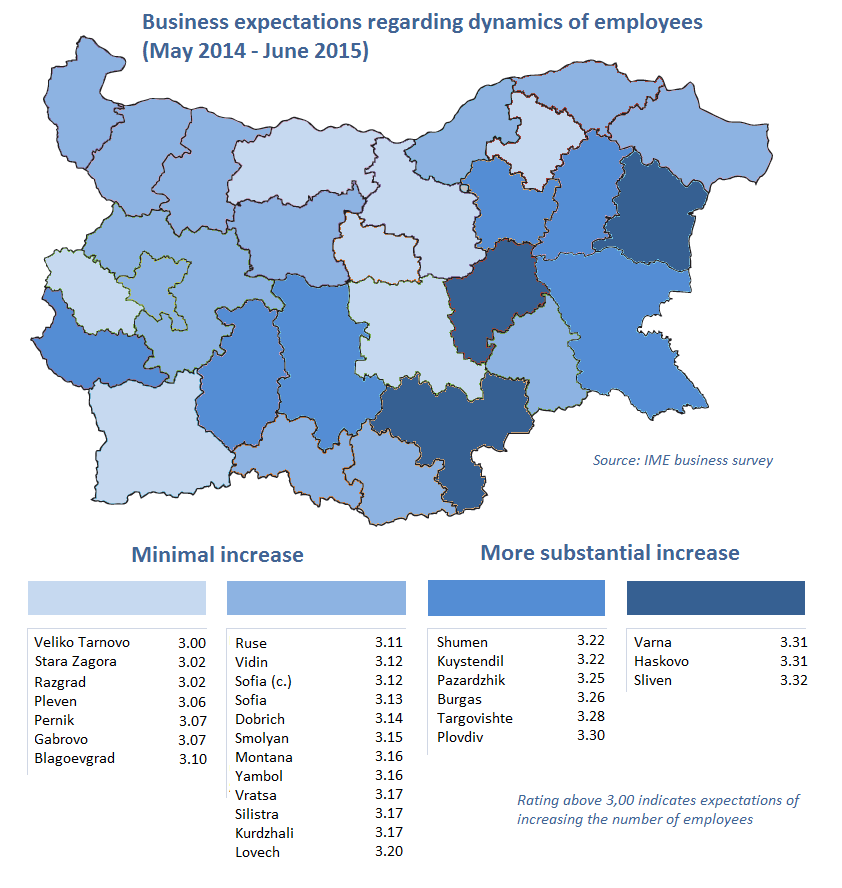
For the purposes of the upcoming second edition of the study “Regional profiles: Indicators of Development”, in May 2013 IME conducted a survey among 1680 companies nationwide. One its goals, was to examine the expectations of businesses regarding the dynamics of the number of employees in the period June 2013-June 2014. The results are shown in the graph below, by visualizing the expectations of business representatives about increasing or decreasing the number of their employees. Results above 3 show expectations of hiring more staff. Result below 3 point to negative tendencies.
Business expectations regarding the number of employed (June 2013 - June 2014)

Source: IME, „Regional profiles: Indicators of Development 2013“
Note: The data is from May 2013.
Businesses expect that the number of employees will increase in the following 10 districts: Burgas, Targovishte, Pazardzhik, Pernik, Plovdiv, Blagoevgrad, Yambol, Dobrich, Sliven and Kardzhali. Oddly enough, only Dobrich and Targovishte are part of Northern Bulgaria. There is no expected change in the number of employees in Kyustendil and Stara Zagora and in all other districts this number is expected to fall.
It seems more than clear that an exact assessment of labor market conditions in Bulgaria could be made at the end of the third quarter, when most of the seasonal workers will be dismissed. The question is whether the momentum in the labor market and perhaps in the economy in general will be sufficient to keep employment high in comparison to previous year. The successful summer season makes evaluations based on the dynamics of previous years uncertain. Employment numbers may be positive but so far business expectations remain subdued.
Raising the minimum thresholds makes the labor of more than half of the employed in poorer districts more expensive.
Talks on changes in the social security system have started again, against the background of continuing protests in the country and the news of a possible budget revision. We have been hearing all kinds of extravagant and even unconstitutional suggestions, such as the proposal to “take away” money from the private pension funds, but yet again little attention is being paid to the influence of minimum insurance thresholds on employment levels in the country. Let’s not forget that neglecting this topic is an invariable criticism in the reports and statements of the EC[1] and the IMF[2]. We now have access to more data, which clearly show the size of the problem and have not been publicly available until now.
In the past year we published an analysis of the effects of social security and regulatory burdens on the labour force in the country. For the first time, using detailed data, we can prove that one out of every four people is insured on or close to the minimum threshold. Now, thanks to the work done by our colleagues from National Social Security Institute, we have 2012 data and a breakdown by regions[3]. It has been pointed out analytically more than once that this problem is mainly on regional level, but never before have had access to detailed regional data. And the statistics are more than alarming.
As expected, such a problem is more or less non-existent in Sofia – only 5% of those working in the capital are insured on or close to the minimum social insurance income. In other words, wages in Sofia are relatively high and raising the minimum insurance thresholds does have a serious influence. But the situation in the country is different. In Haskovo for example, almost 60% of all workers are insured on or close to the minimum. This means that raising the minimum thresholds automatically makes the labour of more than half of the employed in Haskovo more expensive, which inevitably pushes employment down.
Insured on or close to the minimum threshold (% of the insured by regions, 2010 – 2012)

Source: NSSI
*Data of the NSSI for the 16 economic activities for the period 2010 – 2012 have been used, which encompasses almost 1 million insured persons. We assumed insured persons on or close to the minimum to be all those, who are insured on or close to the threshold – with a tolerance range of 10% above the administratively specified threshold.
The same is true for other regions as well – in Blagoevgrad, Vidin, and Pleven 50% of the workers are insured close to the minimum. In Ruse and Varna, 40% are close to the minimum. In other words, if we exclude Sofia, minimum insurance thresholds play a crucial role in the country, because every change in them automatically influences at least half of the employed. Even more, in the past several years, the impact of the minimum thresholds is increasing. Varna was hit the hardest – in 2010 25% were close to the minimum thresholds, while in 2012 these were already close to 40%.
All of this is not quite surprising and just confirms the arguments already expressed. The system of minimum insurance thresholds has immense influence in the countryside, which is neglected in view of Sofia. The blind raising of minimum thresholds in times of crisis and decreasing employment has made it so that more than half of the employed in the country (excluding Sofia) are insured on or close to the minimum and every increase in these thresholds automatically depresses employment levels in many regions. This is one of the explanations behind the problems on the labour market and the lack of new jobs, which is also confirmed by international observers and institutions and the detailed regional data. Inexplicable is the desire of the institutions to comment on all kinds of topics, including unconstitutional ones, but persistently avoid all criticism against the system of minimum insurance thresholds and its effects on employment.
[1] The position of the EC (here): “… To reevaluate the minimum insurance thresholds, in order to make sure that the system does not raise the cost of hiring low-skilled workers too much…”
[2] The position of the IMF (here): “… The effect of the higher minimum wages and minimum social security threshold on employment must also be evaluated…”
[3] Data of the NSSI for the 16 economic activities for the period 2010 – 2012 have been used, which encompasses almost 1 million insured persons. We assumed insured persons on or close to the minimum to be all those, who are insured on or close to the threshold – with a tolerance of 10% above the administratively specified threshold.
�
The project "Regional Profiles: Indicators of Development" is carried out with the support of the America for Bulgaria Foundation.
During the second part of our trip we visited the regions of Vratsa, Pleven, Lovech, Gabrovo, Veliko Tarnovo, Targivishte, Shumen, Razgrad, Ruse, Silistra, Dobrich and Varna.
Petar Ganev
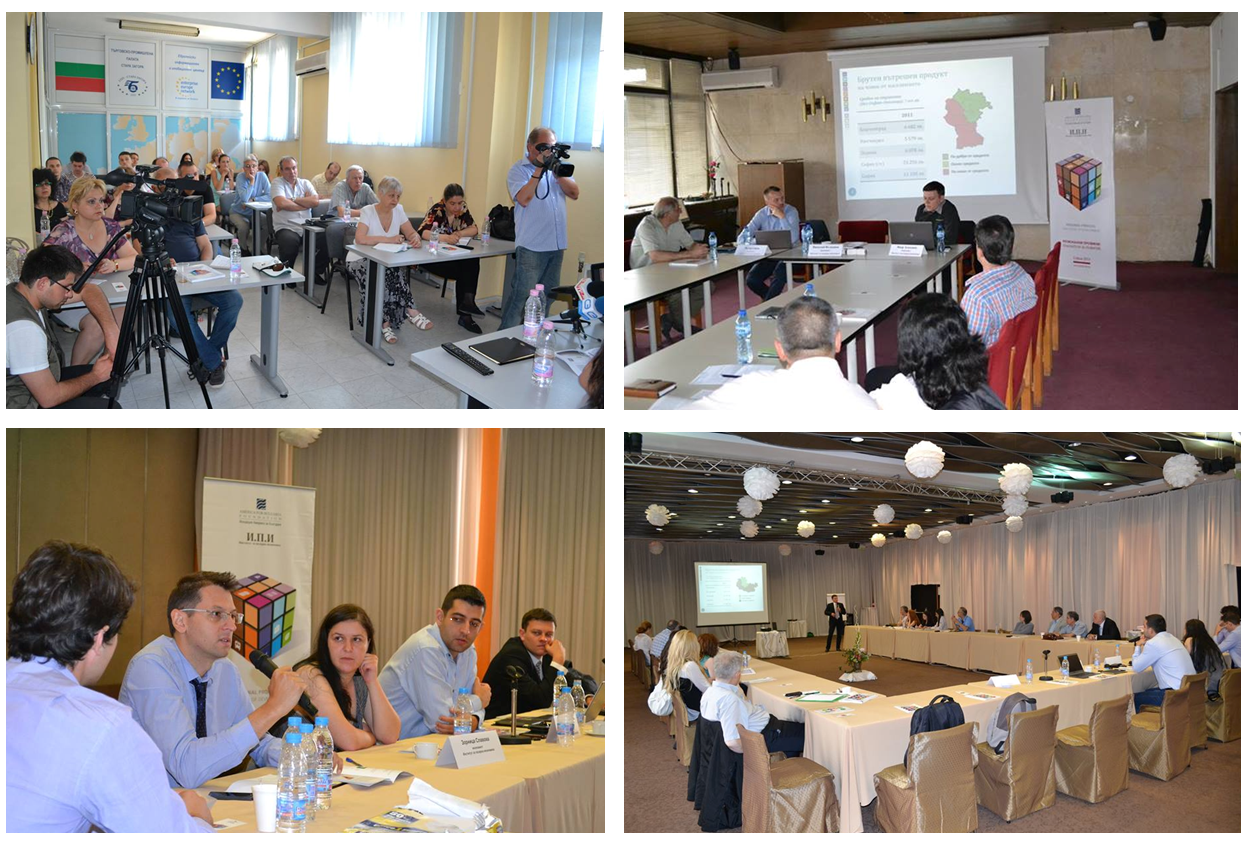
In mid-June 2013 for a second year in a row IME embarked on а tour of the 28 districts in Bulgaria as a part of the upcoming second edition of the study “Regional Profiles: Indicators of Development”. By holding meetings with representatives of non-governmental organizations, business associations and regional authorities, IME’s team aims to acquire direct impressions of the socio-economic environment in each district.
During the second part of our trip we visited the regions of Vratsa, Pleven, Lovech, Gabrovo, Veliko Tarnovo, Targivishte, Shumen, Razgrad, Ruse, Silistra, Dobrich and Varna. We will use our observations from these visits for the completion of each region’s profile in the upcoming second edition of our study. Some of the underlying socio-economic trends that we observed in the regions of Northern Bulgaria are:
IME would like to extend its gratitude to all of our partners and especially the representatives of the Bulgarian Chamber of Commerce and Industry (BCCI) for their cooperation in the organization of local meetings and workshops.
The project "Regional Profiles: Indicators of Development" is carried out with the support of the America for Bulgaria Foundation.
The assessment “Quality of life in the districts”, drafted by the IME, is an attempt to combine the methodologies the globally recognised indices and apply them on a regional level in Bulgaria.
The usual methodology in the estimation of quality of life is to assess it on a national level, not on a regional one. With the exception of several publications, ranking the cities in various countries, there are no studies, which rank individual regions.
Studies on a national level can be divided into two types – objective and subjective. The latter ones use various public polls in order to calculate an estimate of the quality of life. The objective studies are based on different statistical data, combined into one final value, which measures quality of life. Such studies are for example The Economist Intelligence Unit’s Quality-of-Life Index from 2005, the popular Human Development Index, and the OECD’s Better Life Index.
The assessment “Quality of life in the districts”, drafted by the IME, is an attempt to combine the methodologies the globally recognised indices and apply them on a regional level in Bulgaria. The goal of the assessment is to be, as much as it is possible, yet another factor used when comparing the different districts in Bulgaria. In order to minimize subjectivity, the different indicators are given equal weights in the final result. This assessment is base on the IME’s study “Regional Profiles: Indicators of Development”.

Source: IME’s calculations
As is obvious from the districts ranking, the presence of a large district centre does not always mean a better quality of life. The traditionally cited as large and prosperous districts of Varna and Burgas give way to smaller ones, such as Gabrovo and Pazardzhik. The large difference between Sofia (capital) and the rest of the districts is due to its good performance in one indicator, but in several Sofia lags behind. This is one of the main strengths of the index – first place in one of the sub-factors is not enough to raise the district to a high level. Some other main conclusions, which can be drawn from the study, are:
When assessing the performance of the districts, we’ve used only data from the latest available. Because of the nature of the used data and the method of its collection, this year varies (2009 to 2012). You can see the specific indicators and their relevant years below.
The next step is to normalise the data. This way the data are equated to values close to one another. In our case, the normalisation takes the highest value as 1 and the lowest value as 0. The rest of the data is spread between these two values.
The resulting values are then averaged by the number of indicators (12). This means that they are effectively given equal weights.

The project "Regional Profiles: Indicators of Development" is carried out with the support of the America for Bulgaria Foundation.
If the income in the capital stopped rising in 2012 and income in the rest of the districts kept its rate of increase, the first ones to catch up to Sofia would be Stara Zagora and Pernik (in 2014).
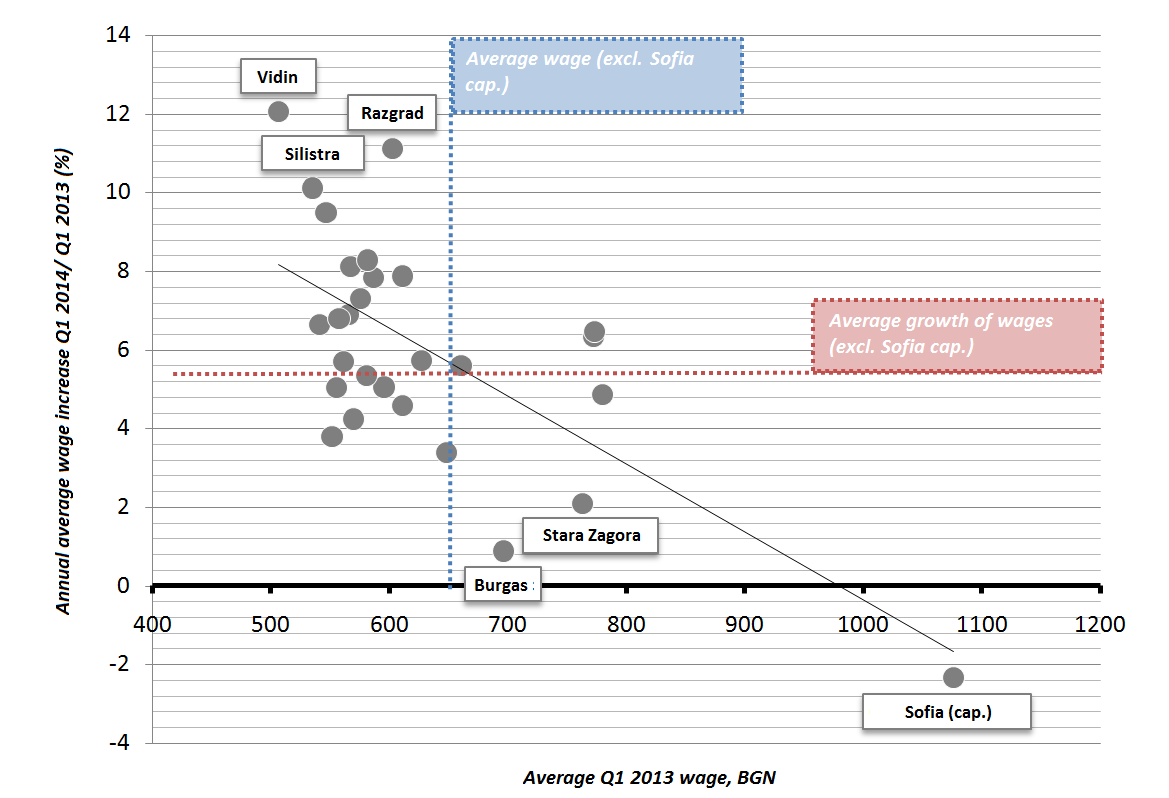
The economic crisis continues to deepen the differences between the capital and the rest of the country’s districts. This is true not only for indicators such as unemployment and employment, but also for the levels of average annual income. In this case, we take a look at the total earnings, which include monetary income (salary and other income, pensions, social benefits, income from sales and other transfers), as well as quantified natural income.
For the period from 2001 to 2011, the average annual growth rate of income in the capital is 12.36%, while the national average is 9.05%. In 19 out of the 28 districts, income is rising at a rate, lower than the national average. The only districts, which shows a higher growth rate of the income, compared to the capital, is Stara Zagora – 12.54% per year. Despite this, the average annual income in Stara Zagora remains � less than that in Sofia (capital) in 2011, because of the lower base in the beginning of the period.
Graph 1: Average annual growth rate of the total income per household member in the period 2001 – 2011, %

Source: NSI, IME’s calculations
Note: We have defined the growth rate as “fast” in districts, where the latter is higher by at least 1 percentage point the national average. The “medium” growth rate is lower or higher by less than 1 percentage point. A rate lower by more than 1 �percentage point means that the district falls into the category of those with “slowly” growing total income.
If the average annual growth rate, observed in the period 2001 – 2011, stays the same, it would be impossible to catch up to the capital[1]. Because of this, in order to illustrate the lag in the level of income in years, we assume that the income in the different districts will continue to rise with same average annual rate as in the period 2001 – 2011. Also, we assume that the real rise in income in the capital stops in 2012 and from this point on it rises only with the rate of inflation.[2]
Graph 2: When the rest of the country’s district will catch up to the capital

Source: NSI, IME’s calculations
If the income in the capital stopped rising in 2012 and income in the rest of the districts kept its rate of increase, the first ones to catch up to Sofia would be Stara Zagora and Pernik (in 2014). Several years later, the same would achieve Smolyan, Ruse, Pleven, and Plovdiv. The last ones to do so would be Vidin (in 2033), Silistra (in 2037), and Pazarzhik (2039).
This dynamic is, of course, conditional, but it gives a good idea of the time lag between the levels of total income in the capital and the rest of the country.
We should also note the different way, in which the crisis has affected the growth rate of income in the individual districts. For example, in recent years, in districts such as Stara Zagora and Sofia (district) the average annual growth rate of total income is higher than the one in the capital. Despite the development of this trend, significant changes in the overall dynamics in the long term seem unlikely.
Today, all major taxes go to the state budget. The tax on the income that everyone earns makes its way to the...
Math is still not enough 14.04.2026
The share of admissions to secondary education for specialized training has been decreasing in recent years...
The province is not a problem of the capital — it is a problem of politics 03.04.2026
In 2025, 159 Bulgarian municipalities (60% of all) implemented exactly 400 projects included in the...
All municipal projects can start this year – here's how 04.03.2026
Is it possible for all municipal projects in the state budget – worth a total of over 4 billion euros –...