Regional Profiles: Indicators of Development 2015
The IME presents the new edition of "Regional Profiles: Indicators of Development".

For the fourth consecutive year the Institute for Market Economics (IME) presented the only one of its scale and depth study of the social and economic state of districts in Bulgaria. The press-conference took place on November 9th 2015 in BTA. The English version of the study will also be available by the end of the year.
presentation (BG only) | handout (BG only)
The research is published at a time when newly selected mayors are expected to propose the most effective policies for regional development. We believe that the publication would be helpful in resolving these issues because it outlines both the advantages of every district, as well as the challenges they face.

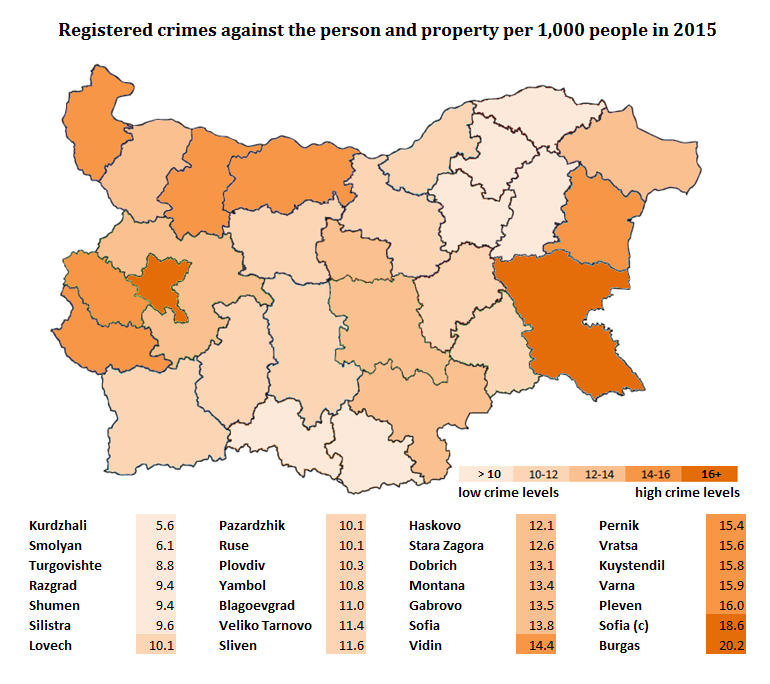
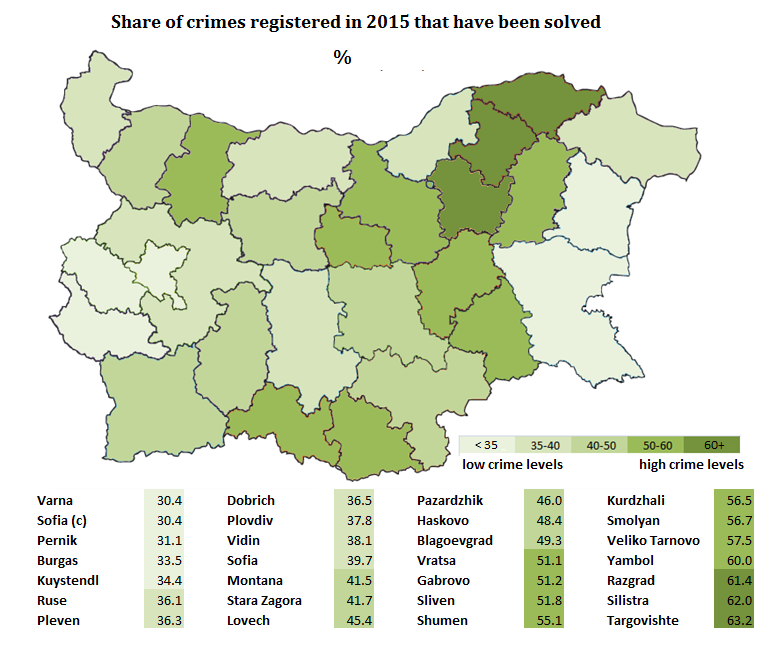
This year’s edition of “Regional Profiles” also includes analysis of the work of local justice systems, due to the undeniable importance of justice for the social environment and the conditions for doing business on local level.
Some of the questions that the study tries to give an answer to are:
The Bulgarian version of the study will be presented on November 9th 2015.
9th November 2015 | 11:00 - 12:00
Pressclub BTA
For the fourth consecutive year the Institute for Market Economics (IME) will present the only one of its scale and depth study of the social and economic state of districts in Bulgaria. The research is published at a time when newly selected mayors are expected to propose the most effective policies for regional development. We believe that the publication would be helpful in resolving these issues because it outlines both the advantages of every district, as well as the challenges they face.
The preconference will be in Bulgarian.
This year’s edition of “Regional Profiles” also includes analysis of the work of local justice systems, due to the undeniable importance of justice for the social environment and the conditions for doing business on local level.
Some of the questions that the study tries to give an answer to are:
The results from the study will be presented by:
Desislava Nikolova, Ph.D, chief economist, IME
Petar Ganev, senior economist, IME
Yavor Aleksiev, economist, IME
Aleksander Tsvetkov, Ph.D, Director, Regiostat
All analyses, data and other materials related to the study will be uploaded on the specialized website of the project at: http://www.regionalprofiles.bg
For more information: Vesela Dobrinova (02/952 62 66, vessela@ime.bg)
The opening of the Employment Agency (EA) data for job vacancies announced in its territorial divisions allows the implementation of a new approach to the analysis of the labor market processes.
The Institute for Market Economics and Infograf are joining the analysis of open data provided by the Open data portal for the Republic of Bulgaria. The results of our work will also be published on the official website of the project "Regional Profiles: indicators of development".
The opening of the Employment Agency (EA) data for job vacancies announced in its territorial divisions allows the implementation of a new approach to the analysis of the labor market processes.
As of September 3rd 2015 the review of the EA data for the vacancies shows that:
Announced payment:
Chart 1: Average monthly salary calculated on the basis of eight-hour working day, for the active job adverts as of September 3, 2015, that contain information on the duration of working time and the offered payment (number of adverts)
Source: EA, IME calculations
Regional Review
Chart 2: Average salary for vacancies in the active job adverts, as of September 3, 2015 (BGN)
Source: EA, IME calculations
Number of unemployed competing for one available job
According to the latest official data of the EA on the number of registered unemployed persons (as of July, 2015), they amount to 309 781 people. The comparison of their number by districts and the number of vacant jobs as of September 3rd, 2015 shows that:
It should be noted that only some of the unemployed are an actual match for the advertised jobs; in some cases there are no unemployed whose qualifications, background and experience fulfill the employer’s demands. I.e. theoretically it is possible to have 67 candidates competing for one vacancy, while all of them are unsuitable for the job.
Chart 3: Number of unemployed who are competing for one vacancy
Source: EA, IME calculations
|
|
Vacancies (as of September 3, 2015) |
Registered unemployed (July) |
Unemployed for 1 vacancy |
Average salary for 8-hour working day |
|
Blagoevgrad |
741 |
19 883 |
27 |
538 |
|
Burgas |
851 |
10 474 |
12 |
525 |
|
Varna |
347 |
12 469 |
36 |
545 |
|
Veliko Tarnovo |
720 |
9 672 |
13 |
428 |
|
Vidin |
298 |
8 246 |
28 |
492 |
|
Vratsa |
283 |
14 447 |
51 |
488 |
|
Gabrovo |
93 |
3 146 |
34 |
619 |
|
Dobrich |
405 |
7 282 |
18 |
502 |
|
Kurdzhali |
598 |
8 154 |
14 |
522 |
|
Kyustendil |
329 |
6 162 |
19 |
476 |
|
Lovech |
407 |
8 334 |
20 |
505 |
|
Montana |
307 |
11 703 |
38 |
491 |
|
Pazardzhik |
850 |
15 967 |
19 |
452 |
|
Pernik |
147 |
5 385 |
37 |
585 |
|
Pleven |
619 |
15 943 |
26 |
483 |
|
Plovdiv |
1 523 |
24 915 |
16 |
541 |
|
Razgrad |
119 |
8 014 |
67 |
489 |
|
Ruse |
945 |
8 169 |
9 |
514 |
|
Silistra |
271 |
7 039 |
26 |
503 |
|
Sliven |
421 |
12 549 |
30 |
449 |
|
Smolyan |
262 |
9 481 |
36 |
476 |
|
Sofia |
478 |
13 104 |
27 |
533 |
|
Sofia (capital) |
1 344 |
18 736 |
14 |
747 |
|
Stara Zagora |
1 087 |
12 315 |
11 |
459 |
|
Targovishte |
246 |
7 902 |
32 |
500 |
|
Haskovo |
292 |
11 318 |
39 |
498 |
|
Shumen |
299 |
12 195 |
41 |
460 |
|
Yambol |
489 |
6 777 |
14 |
491 |
Efficiency and Success Rate of Local Control Mechanisms
The quality of life in a society to a large extent depends on the ability of the local administration to effectively enforce the rules and laws in the particular country. Even good policies have no effect if they cannot be efficiently enforced.
One of the ways to measure the effectiveness of local administrations in their task of enforcing the law and regulations, is to evaluate the results (how many) and effectiveness (at what cost) of the collection of penalties and property fines enforced by municipal administrations.
The conducted analysis of the funds collected by municipal administrations in this manner shows that:
The data shows that the big municipalities, where most of the population is concentrated, have a very bad record in terms of their regulatory functions, which has an effect on the incentive to abide by regulations and consequently – on the quality of life of local inhabitants. According to various data, about 25% of total enforced sanctions are either appealed in court or simply retracted, but despite this, the size of enforced fines which are not collected remains quite significant, which shows that a large number of offenders remain unpunished for breaking the rules.
The lack of effective control for enforcing local regulations means that even if there is an inflow of investment and a quality infrastructure and even transfers from the central budged towards particular local projects, the big municipalities fail at providing living and business conditions which are good enough.

Source: IME, based on the state and local administration’s official reports for 2014
The top 5 municipalities with the biggest absolute sums effectively collected from fines and penalties in 2014 are Plovdiv, Sofia, Varna, Burgas and Aksakovo. These, however, are also municipalities with a low collection rate (except for Varna), i.e. they have collected only 50% of the total size of the sanctions they have enforced.
The most efficient municipalities (sum collected per employee) are Samokov, GotseDelchev, Tutrakan, Simeonovgrad and Shabla.
|
Municipal administrations |
Number of personnel with the authority to enforce bills for regulation violations |
Total property sanctions collected in 2014 (lv.) |
Total property sanctions enforced in 2014 (lv.) |
Sanctions enforced per one administratve official |
Ratio of sanctions collected to sanctions enforced |
Sanctions collected per one administrative official |
|
Plovdiv |
227 |
711 687 |
1 359 526 |
5 989 |
52% |
3 135 |
|
Sofia |
372 |
471 515 |
1 359 245 |
3 654 |
35% |
1 268 |
|
Burgas |
74 |
299 301 |
687 043 |
9 284 |
44% |
4 045 |
|
Varna |
117 |
309 889 |
304 349 |
2 601 |
102% |
2 649 |
|
Stara Zagora |
26 |
10 664 |
165 914 |
6 381 |
6% |
410 |
|
Dobrich |
32 |
88 598 |
126 650 |
3 958 |
70% |
2 769 |
|
Blagoevgrad |
28 |
65 343 |
110 540 |
3 948 |
59% |
2 334 |
|
Pleven |
67 |
47 344 |
79 355 |
1 184 |
60% |
707 |
|
Sliven |
20 |
12 260 |
77 770 |
3 889 |
16% |
613 |
|
Veliko Tarnovo |
21 |
36 440 |
60 055 |
2 860 |
61% |
1 735 |
|
Shumen |
25 |
42 446 |
57 500 |
2 300 |
74% |
1 698 |
Source: IME, based on the state and local administration’s official reports for 2014
The Population is Decreasing, but Municipal Administrations Keep Growing
Georgi Vuldzhev*
Bulgaria has been in a state of demographic decline since the 1990’s. Population across the whole country has been progressively shrinking – in the year 2000 it was 8.1 million people, but by 2014 it has declined to 7.2 million.
Of course, the severity of the demographic decline varies across different regions of the country – due to internal migration from scarcely populated areas to more densely populated ones and from underdeveloped to developed ones, the negative effects are being exacerbated in some areas and diminished in others. Considering these differing processes in various parts of the country it is interesting to analyze the dynamic of the size of municipal administrations throughout the years.
For the purpose of this analysis we shall use municipal administrative personnel per 1000 inhabitants as an indicator. By measuring the variations in that number throughout the years we can see how much influence demographic shifts have on the size of municipal administrations.
In this short comparative study we focus on two years – 2010 and 2014. According to the data compiled by NSI and the official reports of the different municipal administrations in the country, during this period total population has declined by 4%, while the total number of municipal personnel stayed almost the same – declining only by 0.1%. This leads to a rise in the number of administrative personnel per 1000 inhabitants from an average of 2.90 in 2010 to 3.02 in 2014.
|
Municipal administrativepersonnel per 1000 inhabitants |
2010 |
2014 |
Change for the period |
Change for the period in percentages |
|
Blagoevgrad |
3.26 |
3.78 |
0.52 |
16% |
|
Burgas |
3.20 |
3.65 |
0.45 |
14% |
|
Varna |
2.63 |
2.51 |
-0.13 |
-5% |
|
VelikoTarnovo |
3.31 |
3.73 |
0.41 |
13% |
|
Vidin |
6.05 |
6.22 |
0.18 |
3% |
|
Vratza |
3.42 |
3.47 |
0.06 |
2% |
|
Gabrovo |
3.65 |
3.67 |
0.02 |
1% |
|
Dobrich |
6.82 |
7.18 |
0.37 |
5% |
|
Kardzhali |
6.60 |
6.72 |
0.13 |
2% |
|
Kustendil |
4.13 |
4.34 |
0.21 |
5% |
|
Lovech |
3.94 |
4.90 |
0.96 |
24% |
|
Montana |
4.36 |
4.67 |
0.31 |
7% |
|
Pazardjik |
3.33 |
3.63 |
0.30 |
9% |
|
Pernik |
3.13 |
3.39 |
0.26 |
8% |
|
Pleven |
3.47 |
3.28 |
-0.19 |
-6% |
|
Plovdiv |
3.89 |
4.04 |
0.15 |
4% |
|
Razgrad |
4.22 |
4.51 |
0.29 |
7% |
|
Ruse |
2.90 |
2.93 |
0.03 |
1% |
|
Silistra |
4.23 |
4.37 |
0.15 |
3% |
|
Sliven |
2.82 |
2.76 |
-0.06 |
-2% |
|
Smolyan |
5.22 |
5.75 |
0.53 |
10% |
|
Sofia |
4.31 |
4.36 |
0.05 |
1% |
|
Stara Zagora |
2.96 |
3.02 |
0.06 |
2% |
|
Targovishte |
4.37 |
4.64 |
0.27 |
6% |
|
Haskovo |
4.02 |
4.12 |
0.10 |
2% |
|
Shumen |
4.12 |
4.33 |
0.21 |
5% |
|
Yambol |
5.37 |
4.99 |
-0.37 |
-7% |
|
Whole country |
2.90 |
3.02 |
0.12 |
4% |
Source: Official annual reports of the municipalities, NSI, IME’s calculations
As we can see in the table, the districts in which the size of the municipal administration relative to the population is the highest, i.e. we can assume a waste of municipal resources (and consequently – of state resources through state transfers to municipalities) are the same for 2010 and 2014. These provinces are Vidin, Dobrich (without the city itself) Kardzhali, Smolyan and Yambol. The provinces with the lowest number of administrative personnel per 1000 inhabitants in 2010 keep their spot in 2014 as well: Sliven, Ruse, Varna, Stara Zagora, and Pernik. When we take a look at the third column, where we can find the change in the value of the indicator in 2014 as compared to 2010, we notice that the relative size of municipal administrations has declined only in four provinces. These are Yambol (-0.37; -7%), Pleven (-0.19; -6%), Varna (-0.13; -5%), and Sliven (-0.06; - 2%). In all other provinces, the number of administrative personnel per 1000 inhabitants has grown. The provinces where it has grown the most are Lovech (+0.96; +24%); Smolyan (+0.53; +10%), and Blagoevgrad (+0.52; +16%).
It is interesting to also note the size of which particular municipalities underwent the greatest change during the period. On the next two tables you can see exactly this data compared to the shifts in population and the size of the municipal administration in 2014 as compared to 2010.
|
Municipalities with the biggest increase in personnel numbers for the period |
Increase in the number of administrativepersonnel per 1000 inhabitants |
Change in the number of administrativepersonnel |
Change in the size of the population |
|
Belitsa |
128% |
133% |
2% |
|
Sozopol |
160% |
115% |
-17% |
|
Sredets |
70% |
57% |
-7% |
|
Sungurlare |
116% |
105% |
-5% |
|
Tzarevo |
86% |
86% |
0% |
|
Kovachevtsi |
73% |
-3% |
-44% |
|
Municipalities with the greatest decline in personnel size for the period |
Decline in the number of administrativepersonnel per 1000 inhabitants |
Change in the number of administrativepersonnel |
Change in the size of the population |
|
Bregovo |
-27% |
-39% |
-16% |
|
Balchik |
-26% |
-31% |
-8% |
|
Strelcha |
-44% |
-51% |
-12% |
|
Pordim |
-56% |
-23% |
-14% |
|
Sadovo |
-22% |
-25% |
-3% |
|
Pavel Banya |
-20% |
-24% |
-6% |
Source: Official annual reports of the municipalities, NSI, IME’s calculations
It is immediately obvious that the municipalities with the biggest growth in the proportion of local administration size and population size are located in the Burgas province – Sozopol, Sredets, Sungurlare, and Tzarevo. The other two municipalities – Belitsa and Kovachevtsi are located in the provinces Blagoevgrad and Pernik respectively. In five municipalities from the first table the rise in the value of the administrative personnel/1000 inhabitants indicator is caused both by population decline in the municipality and the rising number of employees in the municipal administration. Only in Kovachevtsi is the rise due entirely to the decline in the number of inhabitants and in Belitsa despite the fact that population growth has been positive, the size of the municipal administration has ballooned by 133%!
On the second table we see a very different picture. In all municipalities the number of personnel per 1000 people is lower, with 20% to 40%, despite the poor demographic situation.
Optimally, the rest of the country should be moving in the same direction as the municipalities listed in the last table. The gradual decline in population numbers, combined with the introduction of e-services provided by municipal administrations, suggests that less and less local personnel should be required. The administration has to take steps towards cutting down the numbers of administrative employees, especially in those areas and municipalities where the demographic decline is most serious, and consequently the need for administrative personnel is the lowest.
* Georgi Vuldzhev is an intern at the IME.
The article will be available in English on June 17th, 2015.
Yavor Aleksiev, Victor Trichkov* and Georgi Vuldzhev*
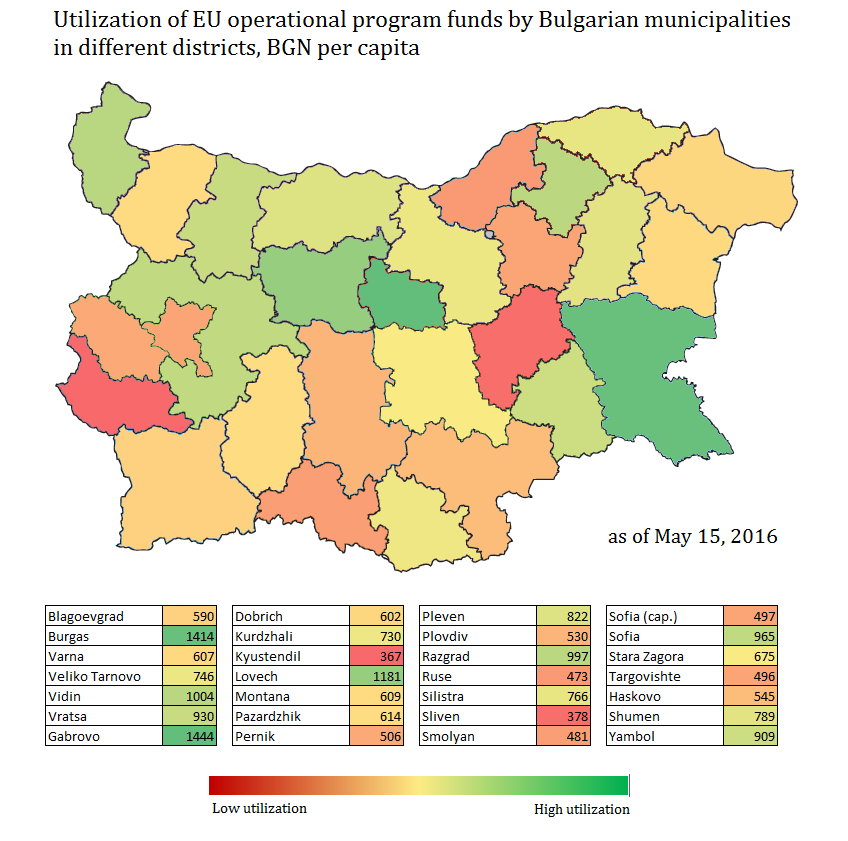
The limited own resources of the Bulgarian municipalities have transformed the successful utilization of European resources in a vital prerequisite for the implementation of a number of regional projects. The widely discussed “addiction” to European money is completely understandable in view of the modest resources of the municipalities themselves to ensure their capital expenditures.
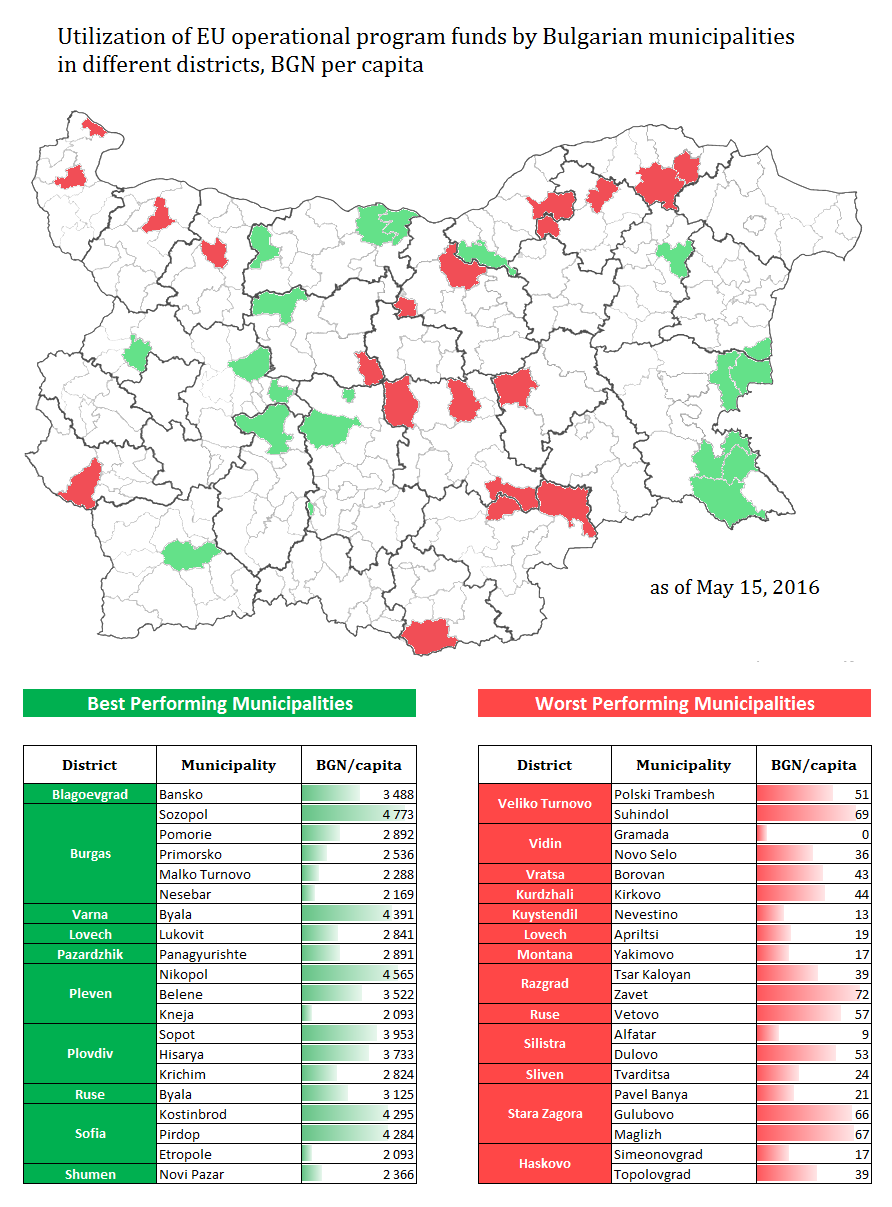
As of January 31, 2015 Bulgarian municipalities have received nearly 4.1 billion lv. as beneficiaries of the structural and cohesion funds of the EU. This is only the value of the amounts that have already been paid. The average utilization rate per capita [1] for the country is 564.9 BGN/capita. This is 49% higher than last year’s 379.8 BGN/capita. In other words, the amount that municipalities have received in only one year is equivalent tohalf of the total amount paid in the period between the country's accession in the EU and January 31, 2014. This trend of faster utilization reflects both the accelerated payment at the end of the previous program period and the increasing project capacity and experience of the municipalities themselves.
Last year the IME made a similar comparison of the amount of funds utilized by the structural and cohesion funds of the EU and the population of the Bulgarian district and municipalities. The main conclusions of our analysis are confirmed by this year’s data:
District level
Once more Gabrovo is the champion in utilization of European funds - 1360 BGN/capita as of 31/01/2015, the second, as well as last year, ranks Burgas (BGN/capita). Followed by Lovech (BGN/capita), managing to overthrow the Sofia district, which last year was the third. The lowest utilization rate is in the districts of Sliven (349 BGN/capita), Ruse (309 BGN/capita), and Kyustendil (286 BGN/capita).
The difference between the district with the most and least utilized resources increased from 787.7 BGN as of 31 January 2014 to 1 074.6 BGN as of January 31, 2015, i.e. differences in the extent of utilization intensified during the last year.

Municipal level
If the data on the utilization on municipal level is to be juxtaposed against thelocal population, most funds per capita were spent by the municipality Konstinbrod – 4 829 BGN per capita (population of 17 265 people). The total amount of funds utilized by the municipality as a beneficiary under the operational programs is 83.4 million BGN as of January 31st, 2015, the municipality has contracts for about 22 million BGN. In comparison, Karlovo municipality where over 50 thousand people live, managed to utilize only 17.1 million BGN or nearly five times less for three times larger population.

In 2015 once again there is a high number of municipalities (30 total) in which the resources utilized as of the 31st of January are under 100 BGN/capita. Last year the district centers of Plovdiv and Kyustendil were in this group, but this year round, they have utilized 123.4 BGN/capita and 161.7 BGN/capita, respectively. As of 31.01.2015 the only municipality which hasn’t utilized any resources via the EU structural programs is Gramada.
It is notable, that in a short one-year period (from 31.01.2014 to 31.01.2015) the largest amount of resources in absolute terms has been utilized in the Varna district’s municipality Byala (1600 BGN/capita), and other holiday resort municipalities like Sozopol (BGN/capita), Nesebar (BGN/capita), Pomorie (BGN/capita) and Bansko (BGN/capita) as well as MalkoTarnovo (BGN/capita).
Comparing the 30 municipalities which have utilized less than 100 BGN/capita of the population and the 30 best performing municipalities in the country, we see that there are no clear territorial tendencies in the levels of utilization of EU funds. What we can see however, is a strong concentration of municipalities with a high level of utilization of funds in the district of Plovdiv and a concentration of municipalities with a low level of utilization of EU funds in the district of Vidin. Maybe the most homogenous territorial “clusters” of municipalities from the standpoint of received resources are:
The problems with the utilization of EU funds are due to both the administrative weaknesses of some of the smaller municipalities and the low quality of the strategic development documents. The presence or lack of close relations between the local and central state administration also plays a role in determining which municipalities get more projects and which get less.
In the accompanying database (in Bulgarian) you can find the resources utilized by every single municipality in the country, for which there is available information, as of 31.01.2015. The best and worst performing municipalities in each district are highlighted. We have also included a document with the official data (in Bulgarian) of the Informational System for the Management and Monitoring of the EU Structural Funds in in Bulgaria, since their latest data (for undisclosed reasons) is no longer available on their official website www.eufunds.bg.
* Victor Trichkov and Georgi Vuldzhev are IME interns.
The first quarter of 2015 unquestionably brought good news for the labour market in Bulgaria.
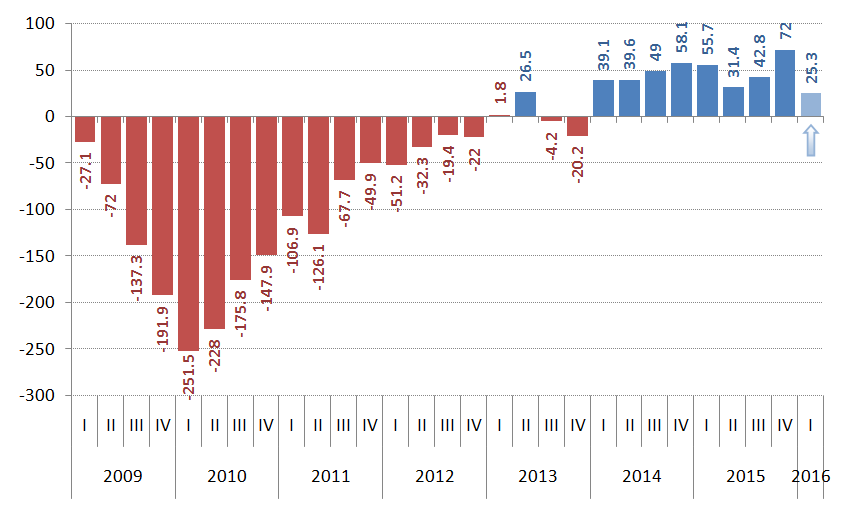
The first quarter of 2015 unquestionably brought good news for the labour market in Bulgaria. According to the NSI, the number of people employed increased by 55.7 thousand compared to the same period of last year. In the first quarter of 2015 47.7% of all people above the age of 15 were employed compared to 46.5% for the same period last year.
At first sight, the recovery of the labour market seems more or less uniform across the country. In Northern Bulgaria the number of employed people is 26.7 thousand higher than that for the same period last year, and in Southern Bulgaria it is 29.1 thousand higher. On an annual basis, the biggest increase in the number of people employed is observed in Varna (28.7 thousand) while the biggest decrease is in Kyustendil (-4.4 thousand).
However, a more in-depth look at the data tells us that, overall, the condition of the labour market in Northern Bulgaria are still disappointing, especially considering the somewhat positive end of last year. If we exclude Varna from the calculations, Northern Bulgaria is actually losing jobs in Q1 2015.
Figure 1: Annual change in the number of people employed (thousands)

Source: NSI
The condition of the labour market in the Northwestern region of the country continues to be extremely severe. The only district in this region in which the number of people employed increased in the first quarter of 2015 is Lovech. At the same time it remains one of the districts with the lowest employment rate in Bulgaria – only 37.7% of the population over 15 years of age is employed. Both the number of people employed and the employment rate have declined in Vidin, Vratsa, and Montana. A loss in jobs was also registered in Pleven, but the simultaneous decrease in population and thus the labor force resulted in a slight annual employment rate increase – from 43.2% to 43.4%.
The tendency of a continuous decline in population is one of the reasons why it is preferable when analysing the recovery of the labour market to include not only the employment rate in the different districts of the country, but also the nominal number of people employed. A lasting positive tendency of growing number of people employed (coupled with a declining population and thus available labour in most districts) can be considered a clear sign for labor market improvement.
Figure 2 should be read as follows:
Figure 2: Consecutive quarters of growth in the number of people employed

Source: NSI
1) Varna is recovering fast
By all indications it seems that 2015 will be the first year since 2009 during which the average annual number of employed people in Varna will remain above 200 000. These stats are significant for two reasons:
2) There are other provinces in Northern Bulgaria which are improving
Positive tendencies are observed in Veliko Tarnovo, where the number of people employed held steadily over 100 000 people and registered a sixth consequent increase on an annual basis. Already in 2011 Veliko Tarnovo displaced Ruse as the district with the highest employment numbers in the Northern central region of the country – a tendency which is likely to persevere in the years to come. After a long period of decline in the number of jobs a positive turn can be observed in the province of Targovisthe as well.
3) In the southern part of the country the most significant improvement is in Stara Zagora where the number of people employed increased by 11.1 thousand. The district of Burgas also experienced its best first quarter for a number of years.
1) The positive data for Southwestern Bulgaria are due only to Sofia (c)
If we exclude Sofia (c) from our calculations the labour market in Southwestern Bulgaria remains in crisis. In the districts closest to the capital – Sofia (district) and Pernik, there are some positive labor market signs, but Kyustendil and Blagoevgrad continue registering record lows in employment numbers. The labour market recovery in these districts is yet to begin.
2) Plovdiv is losing employment for the second consequent quarter
After a long period of rising number of people employed, Plovdiv registered a second consequent quarter of decline. Considering the big number of jobs in the area (280 000 in the last several quarters) the loss of a few hundred employed will hardly exert a serious influence on the average annual employment rate in the area, and it is likely that this decline will be offset in the second quarter of the year.
Even though the employment data is positive for the economy overall, we can clearly see than on a local level the labour market remains depressed in large parts of the country (notably in the Northwest and the Southwest with the exception of the capital). There are still areas (like Blagoevgrad and Kyustendil), which register record lows with regard to the number of people employed. We can also see that the positive tendencies in some districts have come to an end (for example in Plovdiv). For the moment however, the news are predominantly good and a strong second and third quarters for the economy have the potential to “restart” the labour market in some of the underperforming districts of the country.
Today, all major taxes go to the state budget. The tax on the income that everyone earns makes its way to the...
Math is still not enough 14.04.2026
The share of admissions to secondary education for specialized training has been decreasing in recent years...
The province is not a problem of the capital — it is a problem of politics 03.04.2026
In 2025, 159 Bulgarian municipalities (60% of all) implemented exactly 400 projects included in the...
All municipal projects can start this year – here's how 04.03.2026
Is it possible for all municipal projects in the state budget – worth a total of over 4 billion euros –...