Infrastructure
Information
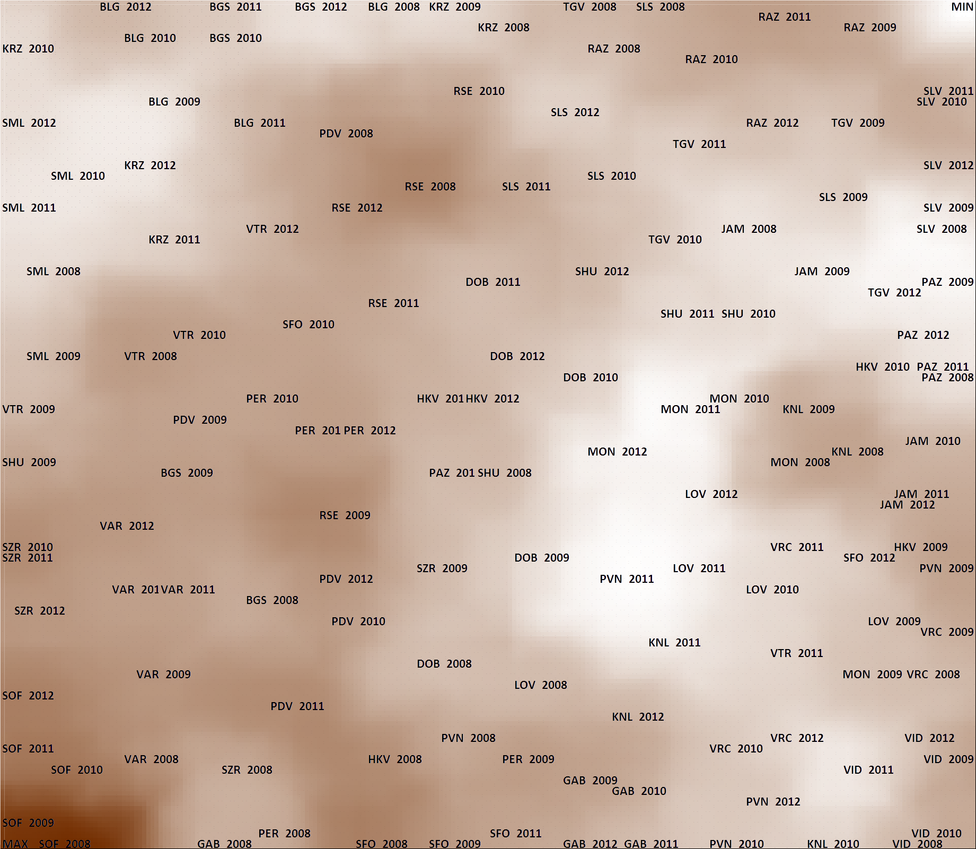
This map shows the development and condition of the infrastructure of all districts during the 2008-2012 period. The dark color in the bottom left corner of the map shows that Sofia (cap) has the best infrastructure, but also registers a negative trend in the 2010-2012 period. The infrastructural development of the districts Ruse (2008 and 2009) and Varna is also good.
The districts of Lovech and Montana have the weakest infrastructural development. Montana shows strong negative trends during the last 3 years of the period, which is indicated by the light color of the map.
Sliven is one of the few districts that show strong positive tendencies during the entire period.
Methodology
The multidimensional analysis of regional development analyzes the overall socio-economic development of Bulgarian districts in the 2008-2012 period, using a wide variety of indicators, grouped in seven categories: economy, infrastructure, demographics, education, healthcare, environment, social environment. The method chosen to achieve this is neural networks – Cohonen Self-Organizing Maps (SOM), to be precise.
Two “fake regions” have been established for the purpose of this analysis. One is a “perfect” region, which scores best (has the highest marks) on all indicators at the same time. The other one is a “worst” region, which scores worst (has the lowest marks). These “fake regions” are used as reference points and benchmarks for assessing the development of the 28 regions during this period. The current state and development of all 28 regions is assessed as positive or negative in comparison to these benchmarks.
One should note that on the maps of the different categories the best-developed territory does not necessarily coincide with the “perfect region”, neither the worst-developed territory coincides with the “worst region”. This happens because the “best” and the “worst” region are defined as such on the basis of all categories at the same time and are therefore fake and do not really exist. Empirical data shows that some regions score high in some categories and low in others.
After the analysis, the districts have been grouped into clusters, formed by Cohonen’s self-organizing maps. The results are represented by two separate methods:
- The clusters are presented through the so-called “unified distance matrix” (U-matrix). The dark zones represent the borders of the clusters, the light ones – the clusters themselves. The darker the border between the clusters, the more they differ from each other and vice versa.
- Each zone on the Cohonen map is characterized by a certain level of development, achieved during the period (low or high) based on the different categories – from economy to social environment. The rankings in the different categories are also represented visually on the different maps, with the more saturated color representing high ranking, while a less saturated – low ranking.
If a region ranks “best” in each of the categories – from economy to social environment, it should match the “perfect” one or be very close to it. In reality, none such exists, so the regions are located all over the map. The reasons for their location can be seen in the analysis of the different categories.
The results thus represented in the Cohonen maps allow us to study the development of all regions for the entire period at the same time, visualizing:
- Difference levels – how much do certain regions differ from the others during one or all years of the period;
- Development directions – whether the development of the regions shows a positive or a negative trend;
- Speed of development – what is the pace of growth or decline;
- Development trajectoryis the re cohesion between the regions, or – even better – an approach towards the “perfect region”.